
Behind the 'Most Commercially Valuable Award': What Did Baixyn Do Right to Help Companies Find Customers and Win Orders with AI?
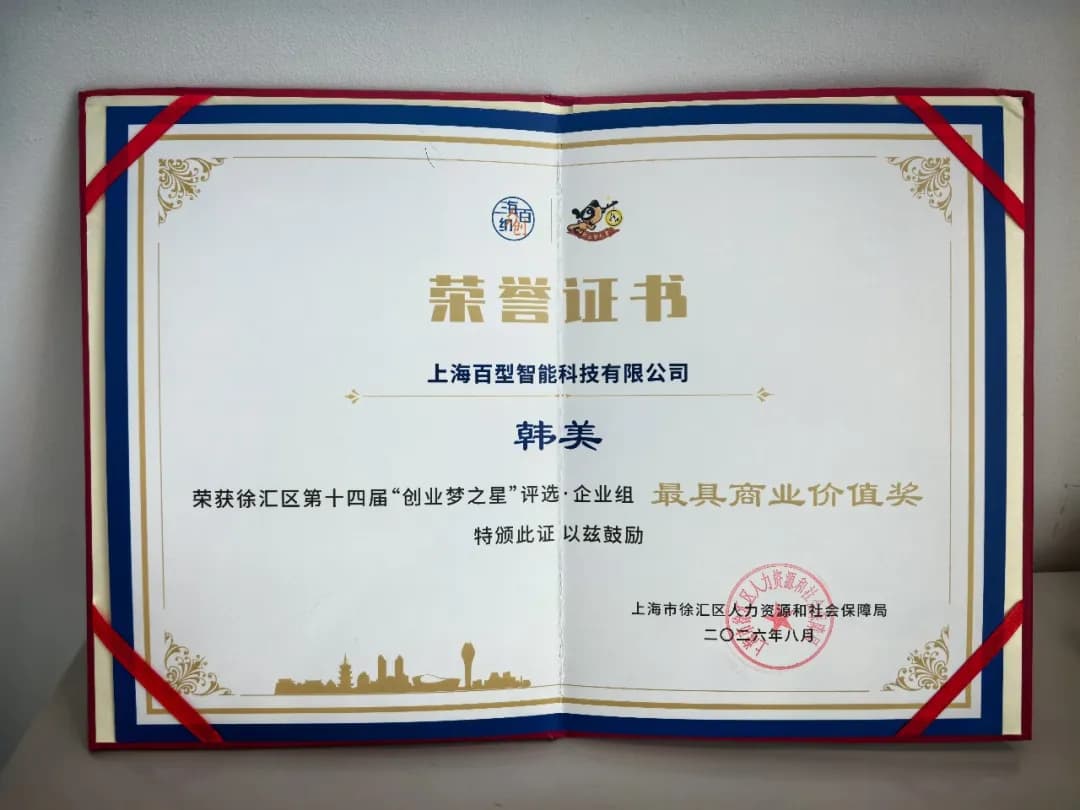
On July 14, Shanghai's Xuhui District announced the 14th 'Entrepreneurial Dream Star' enterprise winners. Baixyn won the 'Most Commercially Valuable Award' for its Foreign Trade Agent Swarm.
Founded in 2024, Baixyn chose a relatively clear AI commercialization path: starting from the growth needs of foreign trade companies, letting AI participate in finding customers, outreach, and obtaining inquiries, and then moving into deal closing. In two years, the company has served more than 1,000 companies; its agents are active in over 160 countries and regions, connect with more than 7 million overseas procurement decision-makers, and have generated hundreds of thousands of procurement inquiries. For an AI startup, these numbers are a direct footnote to 'commercial value.'
First, help foreign trade companies find customers
When founding Baixyn, founder and CEO Han Mei made sales an important scenario for AI implementation and further focused on the customer acquisition challenges Chinese manufacturers face when going global. In her view, growth has long depended heavily on individual salespeople's experience; AI can replicate and scale the judgment, messaging, and marketing strategies of top salespeople, allowing AI to continuously participate in market exploration, customer identification, and proactive outreach.
For foreign trade companies, finding potential customers is only the first step. They must then complete company background research, customer screening, procurement demand assessment, outreach email writing, and continuous follow-up. These steps involve a great deal of repetitive work and depend heavily on salespeople's understanding of the industry, customers, and markets.
Baixyn positions itself as a 'knowledge labor manufacturer for the AI era.' Around foreign trade, it has gradually built a product matrix including acquisition experts, outreach experts, marketing experts, advertising experts, and closing experts. It breaks the sales process into different stages and lets AI execute them continuously, giving market expansion that once depended on manual work a much broader reach.
In this process, AI first brings efficiency gains. Data shows that AI takes about 10 seconds on average to analyze an overseas customer's website, compared with about 16 minutes for a person to complete a similar analysis. Running continuously, it can analyze more than 8,600 companies in 24 hours. For manufacturers that need to develop unfamiliar markets at scale, this means customer screening and market coverage are no longer entirely constrained by the number of salespeople.
Translating into business results
The commercial value of enterprise AI must ultimately be reflected in actual applications and business results.
Baixyn's customers now span industries including machinery and equipment, industrial manufacturing, building materials, auto parts, chemicals, new energy, smart manufacturing, home products, consumer goods, and software services.
Specific cases show that an industrial air purification equipment company had faced scattered overseas customers and low-quality ad leads. After introducing AI sales employees, it generated RMB 12 million in orders with less than RMB 60,000 in investment, cut marketing costs by 80%, and halved its front-end sales team. Another company, in energy-saving films for hotel buildings, previously needed more than six people for related work; with AI, the team shrank to one or two people and closed three deals in three months, entering markets in Europe and Australia. Another company went from a cold start to RMB 10 million-level orders in about three months while opening a new overseas market.
These cases also show AI's value moving from efficiency to business outcomes. Reducing manual input is only one part; more important is expanding overseas customer coverage, obtaining qualified inquiries, and ultimately driving order conversion. AI is thus beginning to connect directly with a company's operating metrics.
From 'one Agent' to enterprise AI
As it served more companies, Baixyn gradually found that simply adding Agents does not solve every problem. A company's product materials may be scattered across its website and internal documents; customer information lives in CRM, email, WhatsApp, and exhibition records; sales experience sits with different employees. Even if a company deploys multiple Agents at once, they may complete their own tasks without collaborating around the same business goal.
In Han Mei's view, one of the core sources of future competitive advantage will be enterprise intelligence. For cross-border B2B companies, AI's value is not just completing a specific task; more importantly, it is whether feedback from execution can settle into enterprise capability and continuously serve acquisition, conversion, and closing.
Based on this judgment, Baixyn moved further from 'AI employees' to the enterprise-level ontology OntoZ. On July 18, at the Future Tech Forum of the 2026 World Artificial Intelligence Conference, Baixyn launched OntoZ and demonstrated enterprise digital twin capabilities on site. After reading a manufacturer's website, products, and historical information, the system can form an initial understanding of the company in about seven minutes, identify product categories, target buyers, and application scenarios, and then have multiple agents carry out customer discovery, marketing outreach, content generation, inquiry identification, and follow-up based on the same enterprise understanding.
In essence, this means AI is moving from 'executing individual tasks' to 'collaborating after understanding the company.' Products, markets, customers, business rules, and execution feedback are organized into one system, while customer replies, inquiry quality, and deal results can in turn inform the next business judgment. For a company, whether an outreach effort was effective, what kind of content is more likely to get a response, and which inquiries ultimately convert into orders can all be continuously recorded and fed back, gradually turning individual experience into reusable business knowledge.
Closing deals becomes the next step
After winning the 'Most Commercially Valuable Award,' Baixyn's next step will continue to extend around going-global growth into deeper business and broader service boundaries—from acquisition and outreach toward conversion and closing—and explore more parts of company operations where AI capabilities can be integrated.
The company has moved its 'inquiry-to-deal' product into internal testing, covering inquiry identification, quotation generation, and order progression. Previously, AI mainly solved 'who to find and how to contact them'; the next stage will further solve 'how to turn an opportunity into an order,' bringing AI into later stages of foreign trade.
The business model is also being explored. Baixyn is trying RaaS (Result as a Service): companies buy not just software seats but more directly high-quality inquiries, deal opportunities, and even business outcomes. At the same time, the company is advancing an A2A ecosystem, planning to open capability interfaces to trade service providers, SaaS vendors, and Agent developers so different agents can collaborate around specific business tasks.
From solving customer acquisition to entering inquiry and closing stages to capturing data and feedback from business processes, Baixyn is extending AI from a point tool in foreign trade into a capability system covering the entire growth chain.