
Baixyn at the HBR Annual Conference Open Mic: Han Mei Shares Her Founding Journey and AI Business Practice
On October 29, at the Harvard Business Review (Chinese) Annual Conference 2026 in Beijing, Baixyn founder and CEO Han Mei shared her journey from business manager to AI entrepreneur and Baixyn's AI business practice in the open mic session.
From the PC internet to the mobile internet to AI, technology keeps changing how companies connect with customers, organize services, and conduct business. After living through these changes, Han Mei chose to put her accumulated business and operations experience into a new entrepreneurial practice: helping AI understand companies and helping going-global businesses keep advancing.
In the talk, she reviewed how that choice took shape and described how real customer needs and business progress gradually clarified Baixyn's direction.
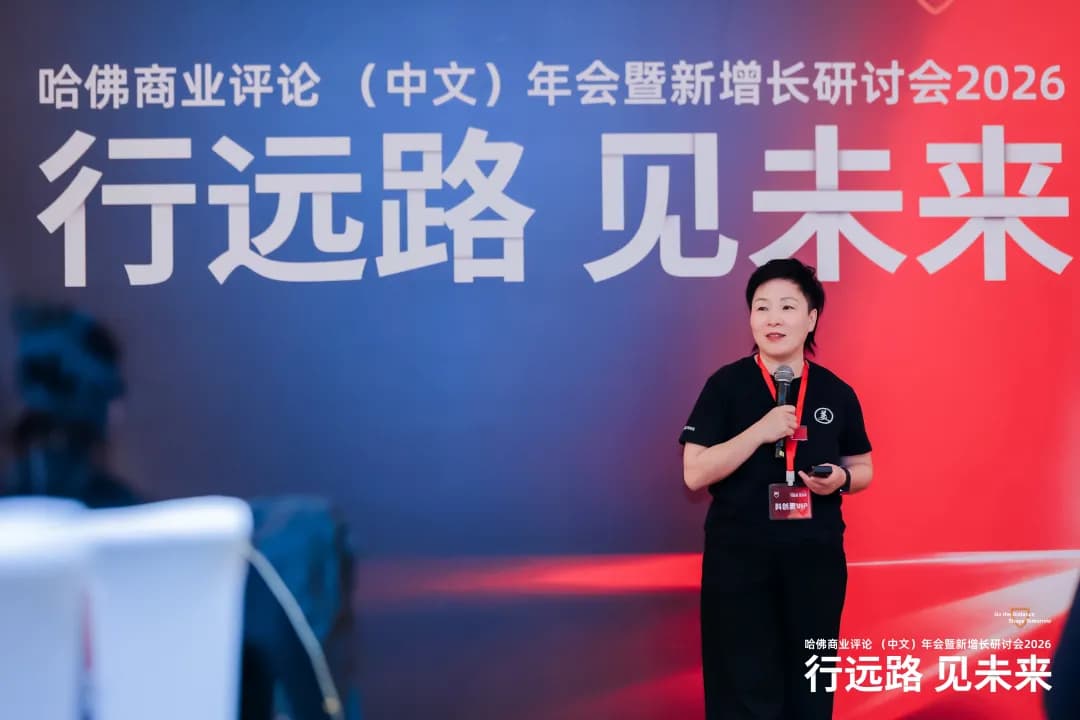
Across three eras, back to real needs
Her experience at Alibaba.com exposed Han Mei to the process of connecting Chinese companies with global buyers and helped her understand a problem many small and medium-sized enterprises share: they have good products but lack the channels and resources to expand into markets.
In the mobile internet era, her work from Alipay to Hello further deepened her understanding of products, real-world scenarios, and operations at scale. As technology entered more everyday situations, what companies needed to understand became more concrete: what users need to accomplish, how services should be organized, and how the business should keep running.
These experiences gradually formed the starting point for how she viewed AI entrepreneurship. Faced with new technological capabilities, Han Mei focused on how they can enter a company's actual operations and help solve long-standing business problems.
From connecting supply and demand to organizing services to exploring AI's participation in business, technology keeps changing, but understanding customers' real needs has always run through it all.
Starting from 'I want an AI foreign trade employee'
In the talk, Han Mei mentioned that a foreign trade customer had made a specific request: they wanted an AI foreign trade employee.
The request made the connection between AI and business operations tangible. The customer wanted someone who could continuously participate in foreign trade work, understand its products, markets, and customers, and help move the business forward.
For Baixyn, this also clarified where the technology startup should focus: around the business growth problems of going-global companies, explore what work AI can take on and how it can collaborate with a company's existing experience and team.
Companies accumulate judgments about products, markets, and customers over years of operation. How to retain that experience and turn sound judgments into sustained action is a question Baixyn has had to keep answering since choosing this direction.
Giving business experience a new way to execute
Around this direction, Baixyn has gradually moved from answering questions and executing tasks toward completing work around business goals.
Baixyn's OntoZ uses an 'enterprise ontology + multi-agent' technology system. Enterprise ontology connects products with markets, customers with opportunities, business rules, and historical feedback; it captures the company's business understanding and gives the enterprise brain a basis for organizing action.
Driven by the enterprise brain, multiple agents collaborate around shared business goals, while the business team handles judgment, trade-offs, and key decisions. Feedback from actual execution also becomes a basis for the company to keep accumulating experience and adjusting its judgments.
This exploration builds on Han Mei's past business and operations experience and raises new requirements: understand how the company operates, bring technology into actual work, and keep testing it through customer use.
Moving from task execution to longer-chain work advancement still requires continuous exploration. The AI-native organization for business operations is a future direction Baixyn continues to watch.
Customer progress makes the choice firmer
At the annual conference, Han Mei used three customer stories to illustrate the changes Baixyn has seen in practice.
In the case of an air purification equipment company, AI helped discover the opportunity with a Maldives distributor. It showed Baixyn that by combining product characteristics, customer scenarios, and business relationships, AI can help companies find market opportunities beyond their existing experience.
The practice of a digital printing company demonstrated the value of continuous customer acquisition and inquiry handling. As the business advanced, AI participated in identification, outreach, and inquiry handling, allowing people to focus more energy on high-value opportunities.
Another company, in outdoor home products, proposed paying Baixyn AI Lisa a 10% commission. This was a cooperation intent raised by the customer and reflected a new expectation: measuring AI's value by business outcomes. Baixyn is still exploring delivery models around qualified inquiries or conversion results.
These practices respond from different angles to the question Baixyn started with: Can AI understand a company's business, and can it create value in actual work?
Customer needs make the direction concrete, while progress in business provides the basis for continued exploration.
In practice, committing to 'All in AI'
Han Mei ended the talk with 'All in AI.'
From a personal journey across three technology eras to the entrepreneurial choice to serve going-global companies, and then to continuous validation in customer practice, this commitment has concrete roots.
For Baixyn, the business and operations experience accumulated in the past needs to combine with AI R&D, systems engineering, and product capabilities. People are responsible for goals, key decisions, and acceptance; enterprise ontology captures shared business understanding; and AI employees collaborate and execute within authorized boundaries.
Let a company's experience be retained, let judgments continuously turn into action, and let AI be tested in real business—this is the entrepreneurial practice Baixyn is advancing and will continue to explore.